Lire et comprendre les mêmes Écritures ? | Reading and Understanding the Same Scriptures? | Leggere e comprendere le stesse Scritture?
For English scroll down | Per l'italiano, scorri verso il basso
Ce colloque invite à présenter des dossiers qui nous permettront d'observer comment les variantes des textes bibliques et la variété de leurs traductions ont pu, à des degrés divers, nourrir l'interprétation et les controverses doctrinales dans le christianisme ancien, principalement du IVe au VIe siècle.
À partir d'études précises portant sur les traditions grecque, latine, syriaque, copte, arménienne et géorgienne, on étudiera l'usage théologique des variantes, ainsi que l'influence possible des controverses sur la traduction, la révision et la transmission des Écritures. Notre conférence cherchera ainsi à déterminer ce que signifiait, pour les communautés chrétiennes anciennes, lire « les mêmes Écritures » malgré la diversité des textes, des langues et des interprétations.
Lire et comprendre les mêmes Écritures ? Textes, traductions, interprétations et controverses dans le christianisme ancien
ARGUMENTAIRE
Entre le IVe et le VIIe siècle, les grandes controverses théologiques se développent au sein de communautés ecclésiales qui reconnaissent l'autorité des mêmes Écritures, sans toujours disposer exactement du même état du texte ni des mêmes traductions (Ayres, 2004 ; Hanson, 1988 ; Young et Teal, 2010 ; McGuckin, 1994). Cette situation résulte en partie de l'histoire antérieure : le Nouveau Testament a circulé en grec sous plusieurs formes et a été traduit très tôt en latin, en syriaque et en copte, puis en arménien et en géorgien. Ces versions ne reposent pas nécessairement sur les mêmes modèles grecs et ont connu elles-mêmes des révisions et des recensions (Parker, 2008 ; Metzger, 1977 ; Cowe, 2012 ; Childers, 2012).
Centré sur les IVe–VIe siècles, avec des remontées ponctuelles aux IIe–IIIe siècles, le colloque interrogera la rencontre entre cette pluralité textuelle et linguistique, et la formation des doctrines chrétiennes. Comment une variante, une traduction ou une révision devient-elle théologiquement signifiante ? Les controverses peuvent-elles influer sur la traduction, la révision ou la transmission de l'Écriture ? Il s'agira de croiser critique textuelle, histoire des versions, patristique et histoire des doctrines, à propos d’une même question : dans l'Antiquité chrétienne, que signifie lire « les mêmes Écritures » ?
- Une même Écriture, mais sous quelles formes ?
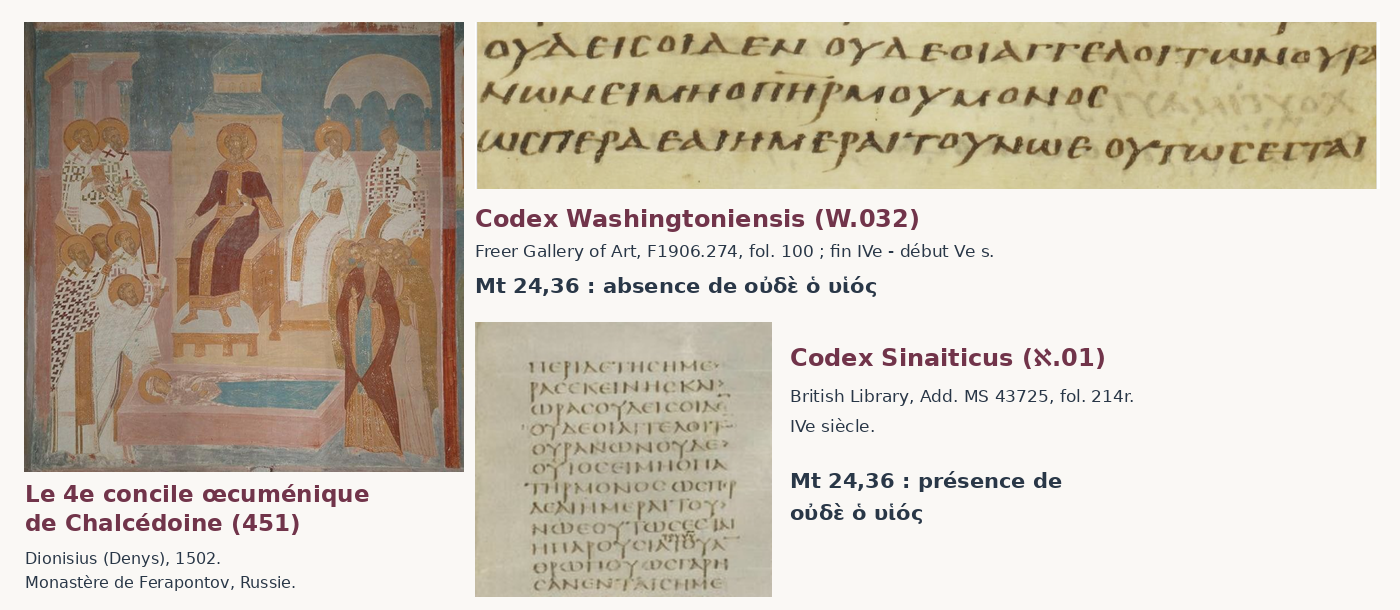
Du IIe au IVe siècle, voire jusqu'au VIIe siècle pour certaines langues, les Écritures sont transmises sous des formes qui peuvent différer en raison de traditions distinctes de copie et de traduction (Parker, 2008 ; Metzger, 1977). Les variantes de Mt 24,36, Mc 1,1 et Lc 22,43–44 ont été discutées en lien avec des enjeux christologiques : la connaissance du Fils, l'identité du Christ et la réalité de son humanité et de sa souffrance. Mais le lien que l'on peut faire entre chaque variante et les controverses n'est pas également documenté (Metzger, 1994 ; Wallace, 2015 ; Head, 1991 ; Blumell, 2014).
Les doctrines ne découlent pas mécaniquement de l'existence de variantes qui les expliqueraient, et les controverses ont pu exercer une influence sur la transmission et l'interprétation du texte (Ehrman, 1993 ; Parker, 2008). Étant donné les débats suscités par Nicée et sa réception, puis les controverses sur l'unité du Christ, le rapport entre divinité et humanité et la réception d'Éphèse et de Chalcédoine, l'enjeu sera d'examiner les cas où une différence textuelle (en grec ou dans les langues de traduction) est effectivement mobilisée dans l'argumentation théologique, et ceux où la controverse paraît avoir contribué à une révision ou à une forme particulière de transmission du texte (Ayres, 2004 ; Hanson, 1988 ; Young et Teal, 2010 ; McGuckin, 1994).
- De la pluralité textuelle à la stabilisation
L'histoire doctrinale doit donc être replacée dans l'histoire matérielle des Écritures. Origène connaît et signale explicitement des formulations divergentes dans les manuscrits (Comm. in Matt. XV,14) (Metzger, 1968 ; Donaldson, 2009). Son activité, d'abord à Alexandrie puis à Césarée, incite à s'interroger sur les collections auxquelles un auteur ancien pouvait avoir accès et sur les possibilités qu'il avait de comparer plusieurs formes d'un même texte (Grafton et Williams, 2006 ; Inowlocki, 2024).
Au IVe siècle, dans les décennies qui suivent Nicée, apparaissent de grands codices bibliques dont le Codex Vaticanus (Vatican, BAV, gr. 1209) et le Codex Sinaiticus (Londres, British Library, Add MS 43725) (Parker, 2008 ; Amphoux, 2013). Dans le même temps, des collections sont attestées dans certains centres, notamment à Césarée, où elles sont associées à Pamphile et à Eusèbe (Grafton et Williams, 2006 ; Inowlocki, 2024). Dès lors, sans supposer une entreprise uniforme de normalisation, on peut se demander comment certaines formes textuelles acquièrent une diffusion et une autorité accrues, et dans quelle mesure les controverses théologiques interviennent dans ce processus.
- Instabilité du texte et évolution de la doctrine
À mesure que des formes du texte néotestamentaire tendent à s'imposer dans certains espaces et certaines traditions, le problème se déplace vers l'usage théologique de ces formes textuelles (Parker, 2008 ; Ehrman et Holmes, 2013). Des controverses peuvent naître de passages présentant des variantes significatives, et des différences de formulation peuvent revêtir une portée doctrinale particulière selon la manière dont sont pensés la filiation, l'engendrement, la divinité, l'Incarnation ou encore la Passion, la mort et la Résurrection (Ayres, 2004 ; Hanson, 1988 ; McGuckin, 1994). Les traités, homélies, lettres, actes conciliaires et Histoires ecclésiastiques seront donc considérés dans la mesure où ils permettent de documenter l'usage d’une forme textuelle particulière, d'une traduction ou d'une révision des Écritures.
Même lorsque le texte tend à se stabiliser, les variantes qui subsistent peuvent continuer à recevoir des interprétations concurrentes au sein de controverses doctrinales (Fogleman et Brumback, 2026). Leur portée dépend alors non seulement de la formulation attestée, mais aussi de la manière dont celle-ci est comprise et mobilisée dans l'argumentation théologique.
- L'importance des langues de traduction
Le grec demeure la principale langue de référence du Nouveau Testament et de nombreuses controverses, mais les Écritures sont très tôt traduites en latin, en syriaque et en copte, puis en arménien et en géorgien (Amphoux, 2014). Ces traductions ne dérivent pas toujours du même état du texte grec et possèdent elles-mêmes leur propre histoire de révisions (Metzger, 1977 ; Cowe, 2012 ; Childers, 2012).
En latin, plusieurs dossiers laissent supposer un usage doctrinal des variantes. En Jn 1,13, Tertullien (De carne Christi 19) défend le singulier natus est, rapporté au Christ, contre nati sunt, rapporté aux croyants de Jn 1,12 et qu'il présente comme une corruption au service de l'interprétation valentinienne des élus spirituels (Jansen, 1982 ; Houghton, 2016 ; de Lamarzelle, 2021). Mt 24,36 constitue un autre cas : dans De fide ad Gratianum 5.16.193, Ambroise affirme que les mots οὐδὲ ὁ υἱός manquent dans d'anciens manuscrits grecs, et accuse ses adversaires d'avoir altéré le texte, à la faveur de la controverse arienne sur la connaissance et la divinité du Fils. Chez Marius Victorinus, le rapport au grec apparaît surtout dans la variation des traductions : ἐν κόλπῳ devient in gremio plutôt que in sinu en Jn 1,18 (Adv. Ar. 4.33) ; πρὸς τὸν θεόν en Jn 1,1 est rendu par circa Deum, ad Deum, apud Deum ou iuxta Deum ; οὐδείς en Jn 1,18 par nullus ou nemo ; et Jn 4,14 oscille entre efficietur in ipso fons aquae scatentis (Adv. Ar. 1.5) et fiet in eo fons aquae salientis (4.6). Ces variations de traduction posent la question de savoir si Victorinus cite plusieurs formes du texte biblique latin ou s'il traduit lui-même une forme grecque sous-jacente (Houghton, 2013 ; 2016 ; Lössl, 2021).
La tradition syriaque fournit également des variantes susceptibles de générer des controverses christologiques. Dès le IIe siècle, la diffusion du Diatessaron marque durablement la transmission évangélique (Petersen, 1994) ; aux IVe–Ve siècles, les versions curetonienne et sinaïtique attestent encore une pluralité textuelle avant la Peshitta (Haelewyck, 2019). La philoxénienne de 507/508 puis la harkléenne de 615/616 révisent le texte d'après le grec, la seconde conservant de nombreuses variantes dans ses marges (Kiraz, 1996 ; Brock, 2021). Ces révisions, qui témoignent de variantes textuelles, peuvent à leur tour susciter des discussions théologiques à leur réception. Ainsi, Philoxène de Mabboug critique certaines formulations de la Peshitta qu'il juge favorables à des lectures « nestoriennes » (Brock, 2021 ; McConaughy, 2025). He 2,9 est révélateur sur ce point : le grec atteste χωρὶς θεοῦ, « sans/en dehors de Dieu », et χάριτι θεοῦ, « par la grâce de Dieu », variation également répercutée en syriaque. La première leçon devient caractéristique de la tradition antiochienne et de l'Église de l'Orient, où elle pouvait être utilisée pour soutenir l'impassibilité divine en rapportant la Passion à l'humanité du Christ ; les auteurs syro-occidentaux privilégient la seconde leçon, plus compatible avec des formulations théopaschites selon lesquelles le Verbe souffre « dans la chair » sans que l'essence divine soit passible. La réception de cette variante devient ainsi elle-même un marqueur de la controverse christologique (Brock, 1985).
Le copte offre un dossier différent. Shenouté (m. 466) intervient dans un milieu où l'Écriture est lue et commentée en copte, tout en mobilisant les catégories de la théologie alexandrine. Dans son Contra Origenistas, se rencontrent citations scripturaires et vocabulaire théologique de tradition grecque, notamment ὑπόστασις, φύσις, οὐσία et ὁμοούσιος (Cristea, 2011 ; Davis, 2008 ; Knecht, 2018). La question devient alors de savoir dans quelle mesure la forme copte du texte biblique, son rapport à un modèle grec ou certains choix de traduction participent à l'argumentation théologique. De même, le Contra Concilium Chalcedonense, conservé seulement en copte, mobilise notamment 1 Jn 2,15 qui utilise le terme de « Père » plutôt que « Dieu », dans son argumentation anti-chalcédonienne (Bianchi, 2025). Cette interrogation peut être étendue aux controverses christologiques postchalcédoniennes, notamment à travers les traductions coptes des Homélies cathédrales de Sévère d’Antioche, où les citations et les interprétations scripturaires peuvent être confrontées aux témoins grecs et syriaques conservés (Morozov, 2024 ; 2026). L'examen de ces traditions permet de chercher si les divergences dans la formulation des passages bibliques relèvent de modèles textuels différents, de pratiques particulières de traduction ou de réécritures susceptibles d'infléchir leur portée doctrinale.
Les traditions arménienne et géorgienne permettent d'élargir la comparaison. La tradition arménienne rapporte qu'après Éphèse, la Bible fit l'objet d'une révision à partir de modèles grecs, mais les étapes de ce processus varient selon les livres (Cowe, 2012). La tradition géorgienne présente, quant à elle, des relations complexes avec le grec, l'arménien et le syriaque (Childers, 2012). Les trajectoires confessionnelles divergentes de deux Églises culturellement proches offrent ainsi un terrain privilégié pour étudier les rapports entre positions à l'égard de Chalcédoine et pratiques de traduction ou de révision biblique (Childers, 2012).
Pour la tradition géorgienne en particulier, la correspondance échangée vers 600–608 entre Kyrion, catholicos de Kartli, et les responsables arméniens Movsēs II, Vrt'anēs K'ert'oł et Abraham Ier fournit le contexte confessionnel dans lequel peuvent être replacées les pratiques de traduction et de révision biblique : elle porte sur Chalcédoine, le « nestorianisme », la communion ecclésiale et l'autorité des conciles ; Kyrion y affirme finalement la foi chalcédonienne et la réception des conciles oecuméniques (Aleksidze, 2014).
Bibliographie
Sources
Aland, B., Aland, K., Karavidopoulos, J., Martini, C. M., & Metzger, B. M. (éds.). (2012). Novum Testamentum Graece (28e éd.). Stuttgart : Deutsche Bibelgesellschaft.
Eusèbe de Césarée, Vie de Constantin IV dans F. Winkelmann (éd.) ; M.-J. Rondeau (trad.)(2013). SC 559. Paris: Cerf.
Kiraz, G. A. (1996). Comparative Edition of the Syriac Gospels: Aligning the Sinaiticus, Curetonianus, Peshitta and Harklean Versions (4 vol.). Leyde: Brill.
Klostermann, E., & Benz, E. (éds.). (1935). Origenes Werke X: Matthäuserklärung I: Die griechisch erhaltenen Tomoi. Die griechischen christlichen Schriftsteller, 40. Leipzig: J. C. Hinrichs.
Marius Victorinus, Adversus Arium, dans P. Henry et P. Hadot (eds.). (1971). Marii Victorini Opera, Pars I: Opera theologica, CSEL 83/1, Vienne: Hoelder-Pichler-Tempsky.
Origène, Commentaire sur Matthieu XV,14, dans Origenes Werke, X, Matthäuserklärung I: Die griechisch erhaltenen Tomoi, éd. Erich Klostermann, coll. Ernst Benz (Leipzig: J. C. Hinrichs, 1935), 387,17–388,7 (=GCS 40).
Thiele, W. (1956–69). Vetus Latina. Die Reste der altlateinischen Bibel. Epistulae Catholicae. VL 26/1. Freiburg: Herder.
Autres ouvrages
Aleksidze, N. (2014). « E00117: The Correspondence between Armenian and Georgian Church Hierarchs (c. 600–608) Preserved in the Book of Letters Celebrates the Service Established for Queen Shushanik (Martyr of Georgia and Armenia, S00075) as a Symbol of Armenian and Georgian Unity ». The Cult of Saints in Late Antiquity, University of Oxford, 2014 (ressource web accedée le 08.10.2026).
Amphoux C.-B. et al. (2014). Manuel de critique textuelle du Nouveau Testament. Introduction générale. LCA 22. Bruxelles : Safran.
Ayres, L. (2004). Nicaea and Its Legacy: An Approach to Fourth-Century Trinitarian Theology. Oxford: Oxford University Press.
Bianchi, C. (2025). « Two Writings Preserved in Coptic against the Council of Chalcedon ». Dans P. Blaudeau et P. Van Nuffelen (éds.), Documenting the Challenges of the Late Antique Miaphysite Church, 101–121. TSEC 41. Leyde: Brill.
Blumell, L. H. (2014). « Luke 22:43–44: An Anti-Docetic Interpolation or an Apologetic Omission? ». TC: A Journal of Biblical Textual Criticism, 19, 1–35.
Brock, S. P. (1985). « Hebrews 2:9b in Syriac Tradition ». Novum Testamentum 27.1, 236–244.
––, (2021). The Bible in the Syriac Tradition (3e éd.). Piscataway, NJ : Gorgias Press. Childers, J. W. (2012). « The Bible in Georgian ». Dans R. Marsden et E. A. Matter (éds.), The New Cambridge History of the Bible, vol. 2, From 600 to 1450 (162–178). Cambridge: Cambridge University Press.
Cowe, P. (2012). « The Bible in Armenian ». Dans R. Marsden et E. A. Matter (éds.), The New Cambridge History of the Bible, vol. 2, From 600 to 1450 (143–161). Cambridge: Cambridge University Press.
Cristea, H.-J. (2011). Schenute von Atripe: Contra Origenistas: Edition des koptischen Textes mit annotierter Übersetzung und Indizes einschließlich einer Übersetzung des 16. Osterfestbriefs des Theophilus in der Fassung des Hieronymus (ep. 96). Studien und Texte zu Antike und Christentum, 60. Tübingen: Mohr Siebeck.
Davis, S. J. (2008). Coptic Christology in Practice: Incarnation and Divine Participation in Late Antique and Medieval Egypt. Oxford: Oxford University Press.
Donaldson, A. M. (2009). Explicit References to New Testament Variant Readings among Greek and Latin Church Fathers. 2 vols. Thèse de doctorat, University of Notre Dame.
Ehrman, B. D. (1993). The Orthodox Corruption of Scripture: The Effect of Early Christological Controversies on the Text of the New Testament. Oxford: Oxford University Press.
Ehrman, B. D., & Holmes, M. W. (éds.). (2013). The Text of the New Testament in Contemporary Research: Essays on the Status Quaestionis (2e éd.). Leyde: Brill.
Fogleman, A., 'The Vision of Christ and the Desire for God: Cyril of Jerusalem's Theophanic Exegesis of Exodus 33,' in A. Fogleman and R. A. Brumback III (eds.), Scripture in the Search for the Doctrine of God: Reading and Receiving the Bible in Christian Tradition. Essays in Honor of D. H. Williams (The Bible in Ancient Christianity 17; Leiden: Brill, 2026), 86–101.
Grafton, A., & Williams, M. (2006). Christianity and the Transformation of the Book: Origen, Eusebius, and the Library of Caesarea. Cambridge, MA: Harvard University Press.
Haelewyck, J.-C. (2019). « The Old Syriac Versions of the Gospels. A Status Quaestionis (From 1842 to the Present Day) ». BABELAO 8, 141–179. (trad. anglaise de Id. 2017. Le Nouveau Testament en syriaque. Études syriaques, 14. Paris, Geuthner, 67–113)
Hanson, R. P. C. (1988). The Search for the Christian Doctrine of God: The Arian Controversy 318–381. Édimbourg: T&T Clark.
Head, P. M. (1991). « A Text-Critical Study of Mark 1.1 ». New Testament Studies, 37, 621–629.
Helton, S. N. (2022). The Text of Acts of the Apostles in the Writings of Origen. Studia Patristica Supplements, 9. Louvain: Peeters. Houghton, H. A. G. (2013). « Patristic Evidence in the New Edition of the Vetus Latina Iohannes ». Dans M. Vinzent, H. A. G. Houghton et L. Mellerin (éds.), Biblical Quotations in Patristic Texts, Studia Patristica 54, 69–85. Leuven: Peeters.
––, (2016). The Latin New Testament: A Guide to Its Early History, Texts, and Manuscripts. Oxford: Oxford University Press.
Inowlocki, S. (2024). « What Caesarea Has to Do with Alexandria? The Christian Library between Myth and Reality ». Scripta Classica Israelica, 43.
Jansen, J. F. 'Tertullian and the New Testament.' The Second Century: A Journal of Early Christian Studies 2.4 (Winter 1982): 191–207.
Knecht, J. J. (2018). « The Alexandrian Christology of Shenoute of Atripe ». Journal of Eastern Christian Studies, 70, 153–191.
Lamarzelle (de), A. (2021) Filiation du Fils unique et filiation des croyants dans le quatrième évangile : à partir de l'étude de Jn 1,1–18 ; 3 ; 19,16b–42 ; 20,11–18. Études bibliques, Nouvelle série 86. Leuven–Paris–Bristol, CT: Peeters, 2021.
Lössl, J. (2021). « Marius Victorinus: Some Observations on His Use of Commentarial Techniques in His "Theological Treatises" ». Dans J. Verheyden et T. Nicklas (éds.), Early Christian Commentators of the New Testament: Essays on Their Aims, Methods and Strategies, Biblical Tools and Studies 42, 127–146. Leuven: Peeters.
McConaughy, D. L. (2025). « Philoxenus' Text of Acts: An Investigation into His Modifications of the Peshitta Text before and after the Philoxenian Version (507/508) ». Le Muséon, 138(3–4), 271–316.
McGuckin, J. A. (1994). St Cyril of Alexandria: The Christological Controversy. Leyde: Brill.
Messer, A. G. (2011). « Patristic Theology and Recension in Matthew 24.36: An Evaluation of Ehrman’s Text-Critical Methodology ». Dans D. B. Wallace (éd.), Revisiting the Corruption of the New Testament: Manuscript, Patristic, and Apocryphal Evidence, Text and Canon of the New Testament 1, 125–187.
Metzger, B. M. (1968). « Explicit References in the Works of Origen to Variant Readings in New Testament Manuscripts ». Dans Id (éd). Historical and Literary Studies: Pagan, Jewish, and Christian (88–103). Leyde: Brill.
––, (1977). The Early Versions of the New Testament: Their Origin, Transmission, and Limitations. Oxford: Clarendon Press.
––, (1994). A Textual Commentary on the Greek New Testament (2e éd.). Stuttgart: Deutsche Bibelgesellschaft.
Morozov, A. A. (2024). « Coptic Translation of the Cathedral Homily LX of Severus of Antioch: Edition and Russian Translation », Bible and Christian Antiquity, 4 (24), p. 15–45.
––, (2026). « Coptic Translation of the Cathedral Homily XIV of Severus of Antioch: Edition and Russian Translation », Bible and Christian Antiquity, 8 (1), p. 15–57.
Parker, D. C. (2008). An Introduction to the New Testament Manuscripts and Their Texts. Cambridge: Cambridge University Press.
Persig, A. (2023). « The Language of Imperial Cult and Roman Religion in the Latin New Testament: The Latin Renderings of 'Saviour' ». New Testament Studies 69.1, 21–34.
Petersen, W. L. (1994). Tatian's Diatessaron: Its Creation, Dissemination, Significance, and History in Scholarship. Supplements to Vigiliae Christianae 25. Leiden: Brill.
Pomeroy, S. (2026), 'Contesting the Son's Judgment: The Fortune of κρίνειν in Greek Fourth-Century Trinitarian Theology,' in A. Fogleman and R. A. Brumback III (eds.), Scripture in the Search for the Doctrine of God: Reading and Receiving the Bible in Christian Tradition. Essays in Honor of D. H. Williams. The Bible in Ancient Christianity 17; Leiden: Brill. 67–85. Schirner, R. (2015). « Augustine's Explicit References to Variant Readings of the New Testament Text: A Case Study ». TC: A Journal of Biblical Textual Criticism 20, 1–13.
Skeat, T. C. (1999). « The Codex Sinaiticus, the Codex Vaticanus, and Constantine ». Journal of Theological Studies, 50.2, 583–625.
Steinfeld, M. R. (2016). The Text of Romans, Second Corinthians, and Galatians in the Writings of Origen of Alexandria. Thèse de doctorat, University of Birmingham.
Wallace, D. B. (2015). « The Son's Ignorance in Matthew 24:36: An Exercise in Textual and Redaction Criticism ». Dans D. M. Gurtner, J. Hernández Jr. et P. Foster (éds..), Studies on the Text of the New Testament and Early Christianity: Essays in Honour of Michael W. Holmes (178–205). Leyde: Brill.
Young, F. M., & Teal, A. (2010). From Nicaea to Chalcedon: A Guide to the Literature and Its Background (2e éd.). Grand Rapids: Baker Academic.
English
This conference invites contributions presenting case studies that will enable us to examine how variants in biblical texts and the diversity of their translations may, to varying degrees, have shaped interpretation and doctrinal controversies in early Christianity, particularly from the fourth to the sixth century.
Through focused studies of the Greek, Latin, Syriac, Coptic, Armenian, and Georgian traditions, we will investigate the theological use of textual variants, as well as the possible influence of doctrinal controversies on the translation, revision, and transmission of Scripture.
The conference will thus seek to determine what it meant for early Christian communities to read 'the same Scriptures' despite the diversity of texts, languages, and interpretations.
Reading and Understanding the Same Scriptures? Texts, Translations, Interpretations, and Controversies in Early Christianity
Introduction
Between the fourth and seventh centuries, major theological controversies developed within ecclesiastical communities that recognized the authority of the same Scriptures, although they did not always possess precisely the same forms of the text or the same translations (Ayres, 2004; Hanson, 1988; Young and Teal, 2010; McGuckin, 1994). This situation resulted partly from earlier developments: the New Testament circulated in Greek in several forms and was translated at an early stage into Latin, Syriac, and Coptic, and subsequently into Armenian and Georgian. These versions were not necessarily based on the same Greek exemplars and themselves underwent revisions and recensions (Parker, 2008; Metzger, 1977; Cowe, 2012; Childers, 2012).
Focusing on the fourth to sixth centuries, with occasional references to the second and third centuries, the conference will explore the relationship between this textual and linguistic plurality and the development of Christian doctrines. How does a textual variant, translation, or revision acquire theological significance? Can doctrinal controversies influence the translation, revision, or transmission of Scripture? The aim is to bring together textual criticism, the history of biblical versions, patristics, and the history of doctrine around a common question: what did it mean to read 'the same Scriptures' in Christian antiquity?
- One Scripture, but in What Forms?
From the second to the fourth century, and in some languages as late as the seventh century, the Scriptures were transmitted in forms that could differ because of distinct copying and translation traditions (Parker, 2008; Metzger, 1977). The variants in Matt. 24:36, Mark 1:1, and Luke 22:43–44 have been discussed in connection with Christological issues: the knowledge of the Son, the identity of Christ, and the reality of his humanity and suffering. Yet the connection between each variant and the doctrinal controversies is not equally well documented (Metzger, 1994; Wallace, 2015; Head, 1991; Blumell, 2014).
Doctrines do not emerge mechanically from the existence of variants that would account for them, and doctrinal controversies may themselves have influenced the transmission and interpretation of the text (Ehrman, 1993; Parker, 2008). In light of the debates prompted by Nicaea and its reception, followed by controversies concerning the unity of Christ, the relationship between divinity and humanity, and the reception of Ephesus and Chalcedon, the aim will be to examine cases in which a textual difference, whether in Greek or in a translated version, was demonstrably used in theological argumentation, as well as cases in which controversy appears to have contributed to a revision or a particular form of textual transmission (Ayres, 2004; Hanson, 1988; Young and Teal, 2010; McGuckin, 1994).
- From Textual Plurality to Stabilization
The history of doctrine must therefore be situated within the material history of the Scriptures. Origen was aware of, and explicitly noted, divergent readings in manuscripts (Comm. in Matt. XV,14) (Metzger, 1968 ; Donaldson, 2009). His work, first in Alexandria and then in Caesarea, raises questions about the collections to which an ancient author could have had access and the opportunities available to compare different forms of the same text (Grafton and Williams, 2006; Inowlocki, 2024).
In the fourth century, during the decades following Nicaea, large biblical codices appeared, including Codex Vaticanus (Vatican, BAV, Vat. gr. 1209) and Codex Sinaiticus (London, British Library, Add MS 43725) (Parker, 2008; Amphoux, 2013). At the same time, collections are attested in certain centers, particularly Caesarea, where they are associated with Pamphilus and Eusebius (Grafton and Williams, 2006; Inowlocki, 2024). Accordingly, without assuming a uniform process of standardization, we may ask how certain textual forms acquired wider circulation and greater authority, and to what extent theological controversies played a role in this process.
- Textual Instability and Doctrinal Development
As particular forms of the New Testament text gradually gained prominence in certain regions and traditions, attention shifted toward the theological use of these textual forms (Parker, 2008; Ehrman and Holmes, 2013). Controversies could arise over passages containing significant variants, and differences in wording could acquire particular doctrinal significance depending on how sonship, generation, divinity, the Incarnation, and the Passion, death, and Resurrection were understood (Ayres, 2004; Hanson, 1988; McGuckin, 1994). Treatises, homilies, letters, conciliar acts, and ecclesiastical histories will therefore be considered insofar as they provide evidence for the use of a particular textual form, translation, or revision of Scripture.
Even when the text tended toward stabilization, surviving variants could continue to receive competing interpretations within doctrinal controversies (Fogleman and Brumback, 2026). Their significance depended not only on the reading attested but also on how it was understood and employed in theological argumentation.
- The importance of Early Versions
Greek remained the principal language of reference for the New Testament and many theological controversies, but the Scriptures were translated at an early stage into Latin, Syriac, and Coptic, and subsequently into Armenian and Georgian (Amphoux, 2014). These translations did not always derive from the same form of the Greek text and had their own histories of revision (Metzger, 1977; Cowe, 2012; Childers, 2012).
In the Latin tradition, several cases suggest that textual variants were used for doctrinal purposes. In John 1:13, Tertullian (De carne Christi 19) defends the singular natus est, referring to Christ, against nati sunt, referring to the believers of John 1:12, which he presents as a corruption intended to support the Valentinian interpretation of the spiritual elect (Jansen, 1982; Houghton, 2016; de Lamarzelle, 2021). Matt. 24:36 offers another example: in De fide ad Gratianum 5.16.193, Ambrose states that the words οὐδὲ ὁ υἱός are absent from ancient Greek manuscripts and accuses his opponents of having altered the text in the context of the Arian controversy concerning the knowledge and divinity of the Son. In Marius Victorinus, the relationship with Greek emerges primarily through variation in translation: ἐν κόλπῳ is rendered in gremio rather than in sinu in John 1:18 (Adv. Ar. 4.33); πρὸς τὸν θεόν in John 1:1 is variously rendered circa Deum, ad Deum, apud Deum, or iuxta Deum; οὐδείς in John 1:18 is translated nullus or nemo; and John 4:14 fluctuates between efficietur in ipso fons aquae scatentis (Adv. Ar. 1.5) and fiet in eo fons aquae salientis (4.6). These variations raise the question of whether Victorinus was quoting several forms of the Latin biblical text or translating an underlying Greek form himself (Houghton, 2013; 2016; Lössl, 2021).
The Syriac tradition also provides variants capable of generating Christological controversies. From the second century onward, the circulation of the Diatessaron had a lasting impact on the transmission of the Gospels (Petersen, 1994); in the fourth and fifth centuries, the Curetonian and Sinaitic versions still attest textual plurality prior to the Peshitta (Haelewyck, 2019). The Philoxenian version of 507/508 and the Harklean version of 615/616 revised the text on the basis of Greek, the latter preserving numerous variants in its margins (Kiraz, 1996; Brock, 2021). These revisions, which bear witness to textual variants, could in turn generate theological debate when received by different communities. Thus, Philoxenus of Mabbug criticized certain formulations of the Peshitta that he considered conducive to 'Nestorian' interpretations (Brock, 2021; McConaughy, 2025). Heb. 2:9 is particularly revealing in this respect: the Greek witnesses attest both χωρὶς θεοῦ, 'apart from/without God', and χάριτι θεοῦ, 'by the grace of God', a variation also reflected in Syriac. The former reading became characteristic of the Antiochene tradition and the Church of the East, where it could be employed to uphold divine impassibility by attributing the Passion to Christ's humanity. West Syriac authors favored the latter reading, which was more compatible with theopaschite formulations according to which the Word suffers 'in the flesh' without the divine essence itself being subject to suffering. The reception of this variant thus became a marker of Christological controversy (Brock, 1985).
The Coptic tradition offers a different case. Shenoute (d. 466) operated in a milieu in which Scripture was read and interpreted in Coptic while drawing on categories of Alexandrian theology. His Contra Origenistas brings together scriptural quotations and theological vocabulary inherited from the Greek tradition, notably ὑπόστασις, φύσις, οὐσία, and ὁμοούσιος (Cristea, 2011; Davis, 2008; Knecht, 2018). The question, then, is to what extent the Coptic form of the biblical text, its relationship to a Greek exemplar, or particular translation choices contributed to theological argumentation. Similarly, the Contra Concilium Chalcedonense, preserved only in Coptic, draws in particular on 1 John 2:15, which uses the term 'Father' rather than 'God', in its anti-Chalcedonian argumentation (Bianchi, 2025). This inquiry can be extended to post-Chalcedonian Christological controversies, particularly through the Coptic translations of the Cathedral Homilies of Severus of Antioch, in which scriptural quotations and interpretations can be compared with surviving Greek and Syriac witnesses (Morozov, 2024; 2026). Examining these traditions makes it possible to investigate whether differences in the wording of biblical passages reflect distinct textual exemplars, translation practices, or reworkings capable of influencing their doctrinal significance.
The Armenian and Georgian traditions broaden the scope of comparison. According to Armenian tradition, the Bible underwent a revision based on Greek exemplars after Ephesus, although the stages of this process vary from book to book (Cowe, 2012). The Georgian tradition, for its part, exhibits complex relationships with Greek, Armenian, and Syriac (Childers, 2012). The divergent confessional trajectories of two culturally closely related Churches thus provide particularly fertile ground for investigating the relationship between attitudes toward Chalcedon and practices of biblical translation or revision (Childers, 2012).
For the Georgian tradition in particular, the correspondence exchanged around 600–608 between Kyrion, Catholicos of Kartli, and the Armenian ecclesiastical leaders Movsēs II, Vrt'anēs K'ert'oł, and Abraham I provides the confessional context in which practices of biblical translation and revision can be situated. This correspondence addresses Chalcedon, 'Nestorianism', ecclesiastical communion, and the authority of councils. Kyrion ultimately affirms the Chalcedonian faith and the reception of the ecumenical councils (Aleksidze, 2014).
Bibliography
See the French version above.
Italiano
Questo convegno invita a presentare studi di casi specifici che consentano di esaminare in che modo le varianti dei testi biblici e la varietà delle loro traduzioni abbiano potuto, in diversa misura, alimentare l'interpretazione e le controversie dottrinali nel cristianesimo antico, soprattutto tra il IV e il VI secolo.
Attraverso studi puntuali sulle tradizioni greca, latina, siriaca, copta, armena e georgiana, si esamineranno l’uso teologico delle varianti testuali e la possibile influenza delle controversie sulla traduzione, sulla revisione e sulla trasmissione delle Scritture.
Il convegno cercherà così di chiarire che cosa significasse, per le comunità cristiane antiche, leggere 'le stesse Scritture' nonostante la diversità dei testi, delle lingue e delle interpretazioni.
Leggere e comprendere le stesse Scritture? Testi, traduzioni, interpretazioni e controversie nel cristianesimo antico
Introduzione
Tra il IV e il VII secolo, le grandi controversie teologiche si svilupparono all'interno di comunità ecclesiali che riconoscevano l'autorità delle medesime Scritture, pur non disponendo sempre esattamente delle stesse forme testuali né delle stesse traduzioni (Ayres, 2004; Hanson, 1988; Young e Teal, 2010; McGuckin, 1994). Questa situazione derivava in parte dalla storia precedente: il Nuovo Testamento aveva circolato in greco in diverse forme ed era stato tradotto assai presto in latino, siriaco e copto, e successivamente in armeno e georgiano. Queste versioni non si basavano necessariamente sugli stessi modelli greci e furono a loro volta oggetto di revisioni e recensioni (Parker, 2008; Metzger, 1977; Cowe, 2012; Childers, 2012).
Incentrato sui secoli IV–VI, con occasionali riferimenti ai secoli II–III, il convegno intende esaminare il rapporto tra questa pluralità testuale e linguistica e la formazione delle dottrine cristiane. In che modo una variante, una traduzione o una revisione acquisisce rilevanza teologica? Le controversie possono influire sulla traduzione, sulla revisione o sulla trasmissione delle Scritture? Si tratterà di mettere in dialogo la critica testuale, la storia delle versioni bibliche, la patristica e la storia delle dottrine attorno a una questione comune: nell'antichità cristiana, che cosa significava leggere 'le stesse Scritture'?
- Una stessa Scrittura, ma in quali forme?
Dal II al IV secolo, e per alcune lingue fino al VII secolo, le Scritture furono trasmesse in forme che potevano differire a causa di distinte tradizioni di copiatura e di traduzione (Parker, 2008; Metzger, 1977). Le varianti di Mt 24,36, Mc 1,1 e Lc 22,43–44 sono state discusse in relazione a questioni cristologiche: la conoscenza del Figlio, l'identità di Cristo e la realtà della sua umanità e della sua sofferenza. Tuttavia, il legame tra ciascuna variante e le controversie dottrinali non è documentato in egual misura (Metzger, 1994; Wallace, 2015; Head, 1991; Blumell, 2014).
Le dottrine non derivano meccanicamente dall'esistenza di varianti che ne costituirebbero la spiegazione, e le controversie dottrinali possono aver esercitato a loro volta un'influenza sulla trasmissione e sull'interpretazione del testo (Ehrman, 1993; Parker, 2008). Alla luce dei dibattiti suscitati da Nicea e dalla sua ricezione, e successivamente delle controversie sull'unità di Cristo, sul rapporto tra divinità e umanità e sulla ricezione di Efeso e Calcedonia, l'obiettivo sarà esaminare i casi in cui una differenza testuale, in greco o nelle lingue di traduzione, sia effettivamente utilizzata nell'argomentazione teologica, nonché quelli in cui la controversia sembra aver contribuito a una revisione o a una particolare forma di trasmissione del testo (Ayres, 2004; Hanson, 1988; Young e Teal, 2010; McGuckin, 1994).
- Dalla pluralità testuale alla stabilizzazione
La storia delle dottrine deve quindi essere collocata nel contesto della storia materiale delle Scritture. Origene conosce e segnala esplicitamente formulazioni divergenti nei manoscritti (Comm. in Matt. XV,14) (Metzger, 1968 ; Donaldson, 2009). La sua attività, dapprima ad Alessandria e poi a Cesarea, induce a interrogarsi sulle raccolte alle quali un autore antico poteva avere accesso e sulle possibilità di confrontare diverse forme di uno stesso testo (Grafton e Williams, 2006; Inowlocki, 2024).
Nel IV secolo, nei decenni successivi a Nicea, compaiono grandi codici biblici, tra cui il Codex Vaticanus (Vaticano, BAV, Vat. gr. 1209) e il Codex Sinaiticus (Londra, British Library, Add MS 43725) (Parker, 2008; Amphoux, 2013). Nello stesso periodo, sono attestate raccolte in alcuni centri, in particolare a Cesarea, dove sono associate a Panfilo e a Eusebio (Grafton e Williams, 2006; Inowlocki, 2024). Pertanto, senza presupporre un processo uniforme di normalizzazione, ci si può chiedere in che modo alcune forme testuali abbiano acquisito una diffusione e un'autorità maggiori e in quale misura le controversie teologiche siano intervenute in questo processo.
- Instabilità del testo e sviluppo della dottrina
Man mano che determinate forme del testo neotestamentario tendevano ad affermarsi in alcuni ambiti geografici e tradizioni, l'attenzione si spostava verso l'uso teologico di queste forme testuali (Parker, 2008; Ehrman e Holmes, 2013). Le controversie potevano nascere da passi che presentavano varianti significative, e le differenze di formulazione potevano assumere una particolare rilevanza dottrinale a seconda del modo in cui venivano concepite la filiazione, la generazione, la divinità, l'Incarnazione, nonché la Passione, la morte e la Risurrezione (Ayres, 2004; Hanson, 1988; McGuckin, 1994). Trattati, omelie, lettere, atti conciliari e storie ecclesiastiche saranno pertanto presi in considerazione nella misura in cui permettono di documentare l'uso di una particolare forma testuale, di una traduzione o di una revisione delle Scritture.
Anche quando il testo tendeva a stabilizzarsi, le varianti ancora esistenti potevano continuare a ricevere interpretazioni divergenti nel contesto delle controversie dottrinali (Fogleman e Brumback, 2026). La loro portata dipendeva quindi non soltanto dalla formulazione attestata, ma anche dal modo in cui essa veniva compresa e utilizzata nell'argomentazione teologica.
- L'importanza delle lingue di traduzione
Il greco rimase la principale lingua di riferimento del Nuovo Testamento e di numerose controversie, ma le Scritture furono tradotte assai presto in latino, siriaco e copto, e successivamente in armeno e georgiano (Amphoux, 2014). Queste traduzioni non derivavano sempre dalla stessa forma del testo greco e possedevano una propria storia di revisioni (Metzger, 1977; Cowe, 2012; Childers, 2012).
Nella tradizione latina, diversi casi lasciano supporre un uso dottrinale delle varianti. In Gv 1,13, Tertulliano (De carne Christi 19) difende il singolare natus est, riferito a Cristo, contro nati sunt, riferito ai credenti di Gv 1,12, che egli presenta come una corruzione volta a sostenere l'interpretazione valentiniana degli eletti spirituali (Jansen, 1982; Houghton, 2016; de Lamarzelle, 2021). Mt 24,36 costituisce un altro caso: nel De fide ad Gratianum 5.16.193, Ambrogio afferma che le parole οὐδὲ ὁ υἱός mancano in antichi manoscritti greci e accusa i suoi avversari di aver alterato il testo nel contesto della controversia ariana sulla conoscenza e sulla divinità del Figlio. In Mario Vittorino, il rapporto con il greco emerge soprattutto attraverso la variazione delle traduzioni: ἐν κόλπῳ diventa in gremio anziché in sinu in Gv 1,18 (Adv. Ar. 4.33); πρὸς τὸν θεόν in Gv 1,1 viene reso con circa Deum, ad Deum, apud Deum oppure iuxta Deum; οὐδείς in Gv 1,18 con nullus oppure nemo; e Gv 4,14 oscilla tra efficietur in ipso fons aquae scatentis (Adv. Ar. 1.5) e fiet in eo fons aquae salientis (4.6). Queste variazioni di traduzione sollevano la questione se Vittorino citi diverse forme del testo biblico latino oppure traduca egli stesso una forma greca sottostante (Houghton, 2013; 2016; Lössl, 2021).
Anche la tradizione siriaca presenta varianti suscettibili di generare controversie cristologiche. Già dal II secolo, la diffusione del Diatessaron segnò profondamente la trasmissione dei Vangeli (Petersen, 1994); nei secoli IV–V, le versioni curetoniana e sinaitica attestano ancora una pluralità testuale anteriore alla Peshitta (Haelewyck, 2019). La versione filosseniana del 507/508 e quella harclense del 615/616 rivedono il testo sulla base del greco, mentre quest'ultima conserva numerose varianti nei margini (Kiraz, 1996; Brock, 2021). Queste revisioni, che testimoniano l'esistenza di varianti testuali, potevano a loro volta suscitare discussioni teologiche al momento della loro ricezione. Filosseno di Mabbug, per esempio, critica alcune formulazioni della Peshitta che ritiene favorevoli a interpretazioni 'nestoriane' (Brock, 2021; McConaughy, 2025). Eb 2,9 è particolarmente significativo al riguardo: il greco attesta χωρὶς θεοῦ, 'senza/al di fuori di Dio', e χάριτι θεοῦ, 'per grazia di Dio', una variazione che si riflette anche nel siriaco. La prima lezione diventa caratteristica della tradizione antiochena e della Chiesa d'Oriente, dove poteva essere utilizzata per sostenere l'impassibilità divina, attribuendo la Passione all'umanità di Cristo. Gli autori siriaco-occidentali privilegiano la seconda lezione, più compatibile con formulazioni teopaschite secondo le quali il Verbo soffre 'nella carne' senza che l'essenza divina sia soggetta alla sofferenza. La ricezione di questa variante diventa così essa stessa un elemento distintivo della controversia cristologica (Brock, 1985).
La tradizione copta offre un caso diverso. Shenute (m. 466) opera in un ambiente nel quale la Scrittura è letta e commentata in copto, pur ricorrendo alle categorie della teologia alessandrina. Nel suo Contra Origenistas si incontrano citazioni scritturistiche e un vocabolario teologico di tradizione greca, in particolare ὑπόστασις, φύσις, οὐσία e ὁμοούσιος (Cristea, 2011; Davis, 2008; Knecht, 2018). La questione diventa allora stabilire in quale misura la forma copta del testo biblico, il suo rapporto con un modello greco o determinate scelte di traduzione partecipino all'argomentazione teologica. Analogamente, il Contra Concilium Chalcedonense, conservato soltanto in copto, utilizza in particolare 1 Gv 2,15, che impiega il termine 'Padre' anziché 'Dio', nella propria argomentazione anticalcedonese (Bianchi, 2025). Questa indagine può essere estesa alle controversie cristologiche postcalcedonesi, soprattutto attraverso le traduzioni copte delle Omelie cattedrali di Severo di Antiochia, nelle quali le citazioni e le interpretazioni scritturistiche possono essere confrontate con i testimoni greci e siriaci conservati (Morozov, 2024; 2026). L'esame di queste tradizioni permette di indagare se le divergenze nella formulazione dei passi biblici derivino da modelli testuali differenti, da pratiche di traduzione o da rielaborazioni suscettibili di modificarne la portata dottrinale.
Le tradizioni armena e georgiana permettono di ampliare il confronto. Secondo la tradizione armena, dopo Efeso la Bibbia fu sottoposta a una revisione sulla base di modelli greci, sebbene le fasi di questo processo varino da libro a libro (Cowe, 2012). La tradizione georgiana presenta, dal canto suo, rapporti complessi con il greco, l'armeno e il siriaco (Childers, 2012). Le divergenti traiettorie confessionali di due Chiese culturalmente vicine offrono pertanto un terreno particolarmente favorevole allo studio dei rapporti tra le posizioni nei confronti di Calcedonia e le pratiche di traduzione o revisione biblica (Childers, 2012).
Per quanto riguarda in particolare la tradizione georgiana, la corrispondenza scambiata intorno al 600–608 tra Kyrion, catholicos di Kartli, e i responsabili ecclesiastici armeni Movsēs II, Vrt'anēs K'ert'oł e Abramo I fornisce il contesto confessionale nel quale possono essere collocate le pratiche di traduzione e revisione biblica. Tale corrispondenza verte su Calcedonia, sul 'nestorianesimo', sulla comunione ecclesiale e sull'autorità dei concili. Kyrion afferma infine la fede calcedonese e il riconoscimento dei concili ecumenici (Aleksidze, 2014).
Bibliografia
Si veda la versione francese qui sopra.
Pour les communicants : les frais d'hébergement et de restauration pendant le colloque seront pris en charge par l'UCO. Dans la mesure du possible, les frais de transport seront assumés par l'institution ou le laboratoire de rattachement de l'intervenant ; toute demande de prise en charge exceptionnelle pourra être signalée au conseil scientifique.
For speakers : Accommodation and meals during the conference will be covered by UCO. Whenever possible, travel expenses should be covered by the speaker's home institution or research unit. Requests for exceptional financial support may be submitted to the scientific committee.
Per gli oratori : Le spese di alloggio e ristorazione durante il convegno saranno a carico dell'UCO. Per quanto possibile, le spese di viaggio dovranno essere sostenute dall'istituzione o dal centro di ricerca di appartenenza del relatore. Eventuali richieste di contributi finanziari eccezionali potranno essere sottoposte al comitato scientifico.
Contributions attendues
Les contributions - d'environ 30 min - pourront être présentées en français, en anglais ou en italien ; pour les communications dans une langue autre que le français, un texte écrit ou un support imprimé sera demandé pour l'auditoire. Elles partiront de dossiers précis mettant en relation texte, traduction, exégèse et controverse doctrinale. Une attention particulière sera portée aux cas où une variante grecque ou une formulation différente attestée dans une traduction ancienne peuvent être reliées à un usage théologique documenté, ou lorsqu'une controverse a influé sur la révision, la transmission ou le choix entre différentes formes textuelles.
La proximité du colloque n'exige pas la présentation de recherches entièrement abouties, mais de dossiers précis, issus de travaux personnels menés dans différentes disciplines, dont les sources et les résultats pourront être mis en commun, discutés et approfondis collectivement. Cette étape de recherche préparera la publication des actes, prévue en 2028 dans une collection chez Brill, De Gruyter ou Peeters.
Call for papers
Contributions, lasting approximately 30 minutes, may be delivered in French, English, or Italian. For presentations delivered in a language other than French, a written text or printed handout will be requested for the audience. Contributions should focus on specific case studies relating text, translation, exegesis, and doctrinal controversy. Particular attention will be given to cases in which a Greek variant or a different wording attested in an ancient translation can be connected with a documented theological use, or in which controversy influenced the revision, transmission, or choice between different textual forms.
The proximity of the conference date should not be regarded as an obstacle. Rather than expecting fully completed research by July 2027, the aim is to enable each participant to present a case study resulting from a focused research effort, to share available information and sources, and to advance the analysis through collective discussion. The conference will thus serve as a stage of scholarly investigation and exchange, with a view to further developing the contributions and publishing the results in the proceedings, scheduled for 2028. The proceedings will be published in a series issued by Brill, De Gruyter, or Peeters.
Contributi
Gli interventi, della durata di circa 30 minuti, potranno essere presentati in francese, inglese o italiano. Per le comunicazioni in una lingua diversa dal francese, sarà richiesto un testo scritto o un supporto cartaceo da distribuire al pubblico. I contributi dovranno partire da casi di studio precisi che mettano in relazione testo, traduzione, esegesi e controversia dottrinale. Particolare attenzione sarà riservata ai casi in cui una variante greca o una diversa formulazione attestata in un'antica traduzione possa essere collegata a un uso teologico documentato, oppure nei quali una controversia abbia influito sulla revisione, sulla trasmissione o sulla scelta tra differenti forme testuali.
Tenuto conto del calendario del convegno, ai partecipanti non si richiede di presentare ricerche già completamente concluse, bensì studi di casi ben definiti, fondati su ricerche individuali condotte in diverse discipline, le cui fonti e i cui risultati potranno essere condivisi, discussi e approfonditi collettivamente. Questa fase di confronto scientifico porrà le basi per la pubblicazione degli atti, prevista per il 2028 in una collana edita da Brill, De Gruyter o Peeters.
- Philippe Blaudeau (Université d'Angers)
- Alexey Morozov (CNRS - HisOma)